
Also On: Xbox Series X|S, Switch, PC
Publisher: Bandai Namco
Developer: Bandai Namco
Medium: Digital
Players: 1
Online: No
ESRB: T
Shadow Labyrinth is one of those games that probably doesn’t make a ton of sense when someone gives you the elevator pitch for the game, which essentially is putting Pac-Man into a Metroidvania. Of course Pac-Man has ventured outside of the confines of his 2D mazes a number of times, but a traditional 2D Metroidvania is certainly new stomping grounds for one of video games oldest mascots. Surprisingly though, it kind of works. It’s not my favorite when compared against the big guns of the genre, but if you’re looking for a budget title to waste some time with, Shadow Labyrinth might be worth a look.
At the onset of the game you’re introduced to the player character, an unnamed, shrouded swordsman with a mechanical arm, capable of wielding the ESP Sword, a powerful relic that also serves as your primary weapon throughout the game. You’re quickly introduced to Puck, a floating robot that suspiciously looks a lot like a 2.5D version of, you guessed it, Pac-Man.
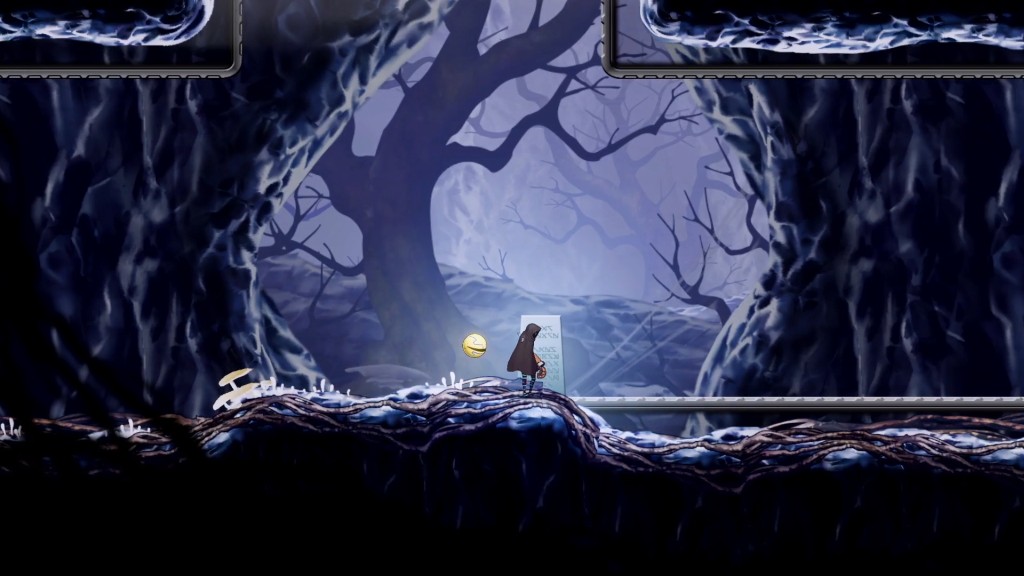 Throughout your adventure Puck floats around as a guide of sorts, and serves as the main narrator/voice throughout. He also provides some additional functionality for your character, like picking up stray pellets that serve as experience to level up your skills with, and also as a means of gathering up resources that can be used to purchase various perks from vendors. That said, this isn’t a family friendly version of Pac-Man that I’d imagine most are familiar with, instead Puck is often surly, sometimes downright murderous in relation to his primary mission. Also, when it comes to resource gathering, Puck does this by helping the hero character shift into GAIA, a giant robot that also serves as an ultimate ability, who then grabs dead enemies and consumes their bodies to both increase the GAIA recharge meter and get unique resources used for those aforementioned perk purchases.
One other primary purpose that Puck serves in Shadow Labyrinth is the ability for the player character to transform into mini-Puck. Throughout the game there are areas of the map that have rails you can touch and then instantly transform into mini-Puck, which alters Puck’s appearance slightly to be more in line with the traditional 2D Pac-Man that we all know and love. These sequences are usually pathways to hidden items or a way of creating shortcuts to prior areas of the map that have been explored. While on the rail you can still attack enemies like you normally would, but otherwise you are pretty defenseless, with only the ability to jump around on the rail in Puck form in order to dodge enemy attacks. Frankly, I’m not a fan of the controls in these sequences. How you make controlling a 2D Pac-Man feel bad is beyond me, but Shadow Labyrinth often does. It’s alleviated a bit by the ability to turn on a jump guideline of sorts, so when you need to make a precise jump from one rail to the next you’ll at least have an idea of where you’re going to land, but by and large I didn’t like these sequences one bit.
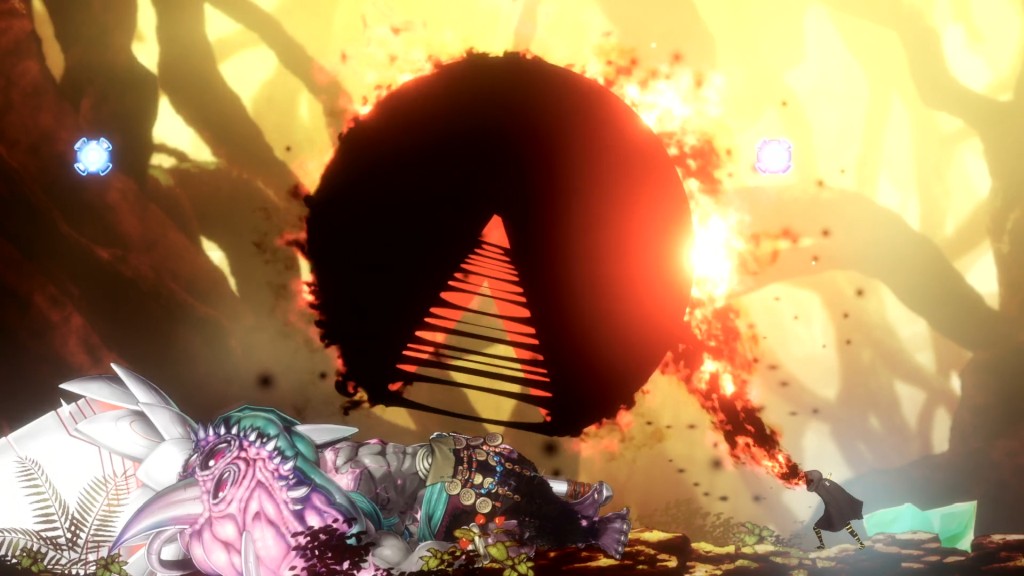 However, the maze monuments you unlock the ability to enter later in the game are a pretty neat use of Pac-Man within Shadow Labyrinth. Throughout your adventure you’ll encounter these silver monuments that have what look like a traditional Pac-Man maze engraved on them. Later in the game you’ll gain the ability to enter these mazes, which actually presents itself more as a throwback to the excellent Championship Edition version of Pac-Man from the old Xbox Live Arcade days. You’ll mostly be clearing stages quickly by consuming pellets and ghosts which will then culminate in a boss battle that’s a frenzy of bounce attacks that ends up being one of the most satisfying moments in Shadow Labyrinth. It’s a far more inventive use of Pac-Man than the rest of the game offers, and it’s a shame that it takes so long to actually unlock these sequences in the game.
Besides the Pac-Man elements, the movement and combat in Shadow Labyrinth is about what you’d expect out of any Metroidvania. Controlling the “Swordsman”, you’ll be able to dash, dodge, perform basic attack strings, and then eventually gain the ability to parry, grapple and so on. The abilities are bog standard Metroidvania fare, and while the general controls feel good, there’s nothing about it that feels fresh or especially modern.
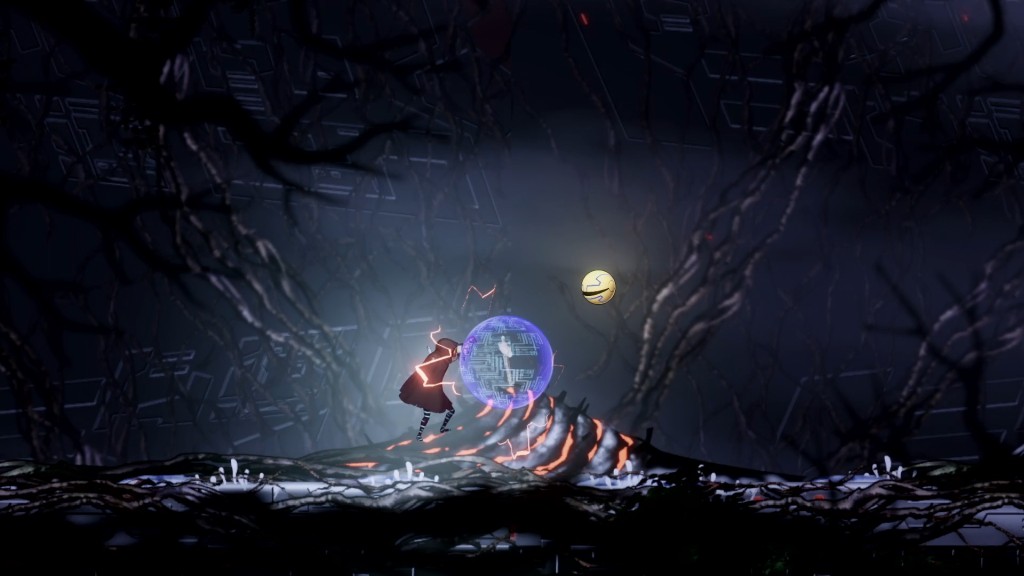 Meanwhile, the environments you’ll explore are drab, and sometimes confusing to navigate. It’s not helped by the infrequent checkpoint system, which often leads to copious amounts of backtracking if you happen to die before hitting the next checkpoint on the map. Shadow Labyrinth also incorporates an annoying warp feature, wherein not all checkpoints are warp points, so if you decide you want to warp around to visit a vendor or previous location, you’ll still end up having to run over already explored ground in order to get back on your critical path. It’s just clunky and annoying to deal with, and over time I felt less compelled to explore because I didn’t want to have to deal with getting reset to a checkpoint that I hit 10 minutes ago if I end up stumbling into a difficult boss fight or enemy encounter that killed me.
I was hopeful for Shadow Labyrinth when it was announced, but as I played the game a lot of that eroded over the hours and hours I spent with it. It’s not a bad game for sure, I’ve played far worse Metroidvania’s over the years, but it’s also not a great game, held back by some archaic design decisions, a mostly bland art design, and some frustrating control moments. There’s enjoyment to be had here, sure, but you really have to struggle through the low points in order to gleam out just a bit of fun from this one.