
Publisher: Sony Interactive Entertainment
Developer: Housemarque
Medium: Digital/Physical
Players: 1
Online: No
ESRB: T
Saros is Housemarque’s second go in the AAA quality roguelike space, following up on 2021’s very popular Returnal. Saros seems to be Housemarque’s answer to anyone who wanted to like Returnal but maybe found it all a little too intimidating and overwhelming. Offering new mechanics to allow players to create custom difficulties and other various other mechanics you’ll encounter, Housemarque is doing everything they can to still keep everything players loved from the first game while opening things up a bit to a wider audience. The visuals, the storytelling, the difficulty, the roguelike elements, everything’s still here. The only thing it lacks that you’ll find in most other roguelikes out there is in general long-term replayability. You certainly can replay near inevitably if you so pleased, but I found my journey at an effective close at about 11 hours.
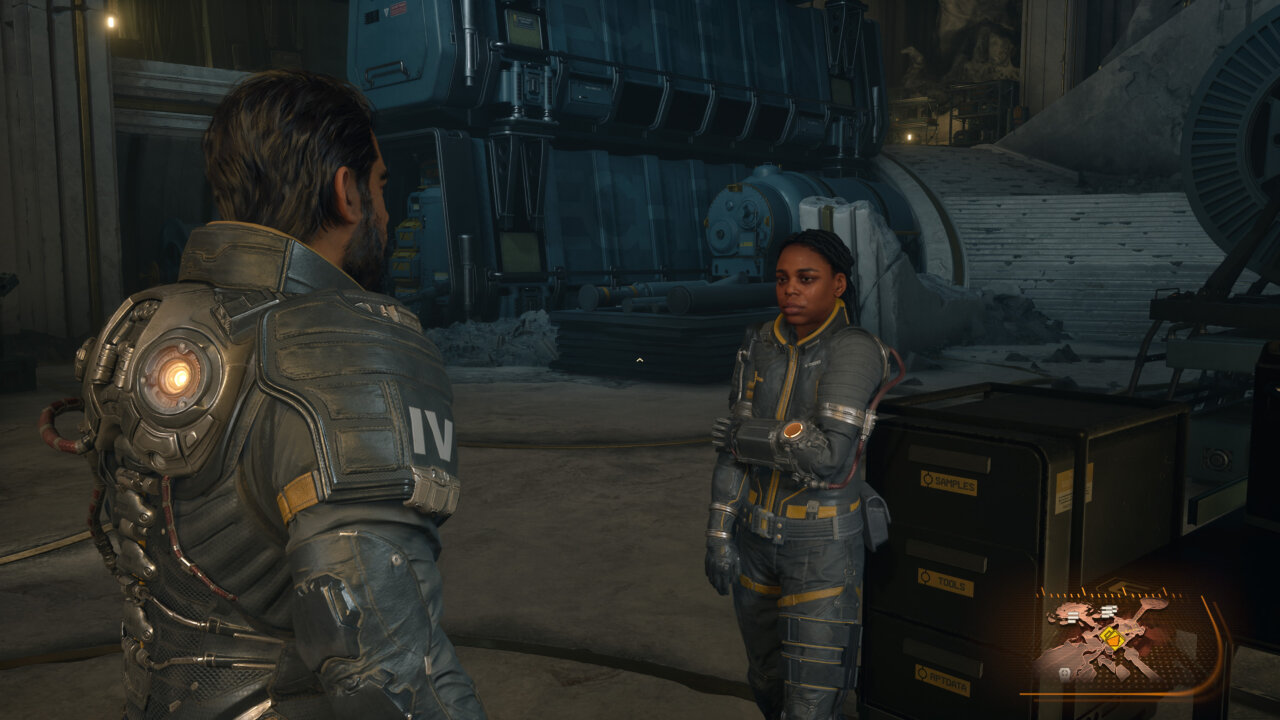
Finding yourself in the boots of Arjun, a man who, as of the beginning of the game, is completely unexplained. Saros has no intention of going down the normal route of a slow opening where you are given lore, setup, or explanation of how you got here. This is all for you to learn as you go through the game. You’re thrust into the shoes of an unknown man, clearly deep in the water of a story that you will never get the full extent of explained clearly to you. Saros is as Returnal was in this way: an esoteric and creative story line told through a lot of dialogue that helps you piece things together, but never holds your hand to guide you along the strings. Characters won’t rattle exposition at you to explain why things are the way they are. Why would they? These people have known each other before you ever took control. They were already struggling before your 4th wall perspective ever arrived. You’re given a brief on-the-field tutorial to introduce you to the mechanics of Saros, then slammed into a super hard boss and most likely killed immediately. You find yourself rematerializing in a home base to no great affair, no confusion from Arjun, and only an assortment of characters suffering in their own stories. Why did Arjun rematerialize out of the floor? Who knows, maybe you’ll learn through playing why nobody made a second thought as to this occurring for the first time from your own perspective.
What you can assume from the opening is that your character and the allies you interact with immediately are the crew members aboard the ship Echelon IV, who has been sent to the planet of Carcosa after the previous three ships all lost contact after arrival. You are seemingly tasked with locating any existence of the crews who arrived before you, but seem to be finding difficulties navigating a planet that seems to change shape every time you look away. The landscape never seems to have a consistent routing through, and the planet’s fauna seem perpetually hellbent on assuring you won’t be exploring. While the point at which you arrive in the Echelon IV’s crew’s story, most of the characters have given up hope, Arjun remains persistent. He must find the crew, he must find “her”. Who? Play and find out.
This is where I love Saros. The storytelling is superb, in my opinion. It really nails down the exact right formula for telling you just enough to never know fully what’s going on, but always keeping you feeling like you’re learning more. The more you learn, the more you realize you don’t know. The lore runs deep tendrils and the active story perpetually delivers wild and interesting moments. Voice logs littered about tell you the stories of those who passed through areas you’re visiting, but they’ll never answer everything. The story gives you just enough to allow a creative mind a million interesting theories on what’s going on. It always answers enough to make the world grounded and it’s great! This is like a more hands-on style of the much beloved storytelling you get from a game like Dark Souls. Likewise there being that you’re always arriving in a world where they stories existed without you having to have been present. Make sense of what’s left behind on your own.
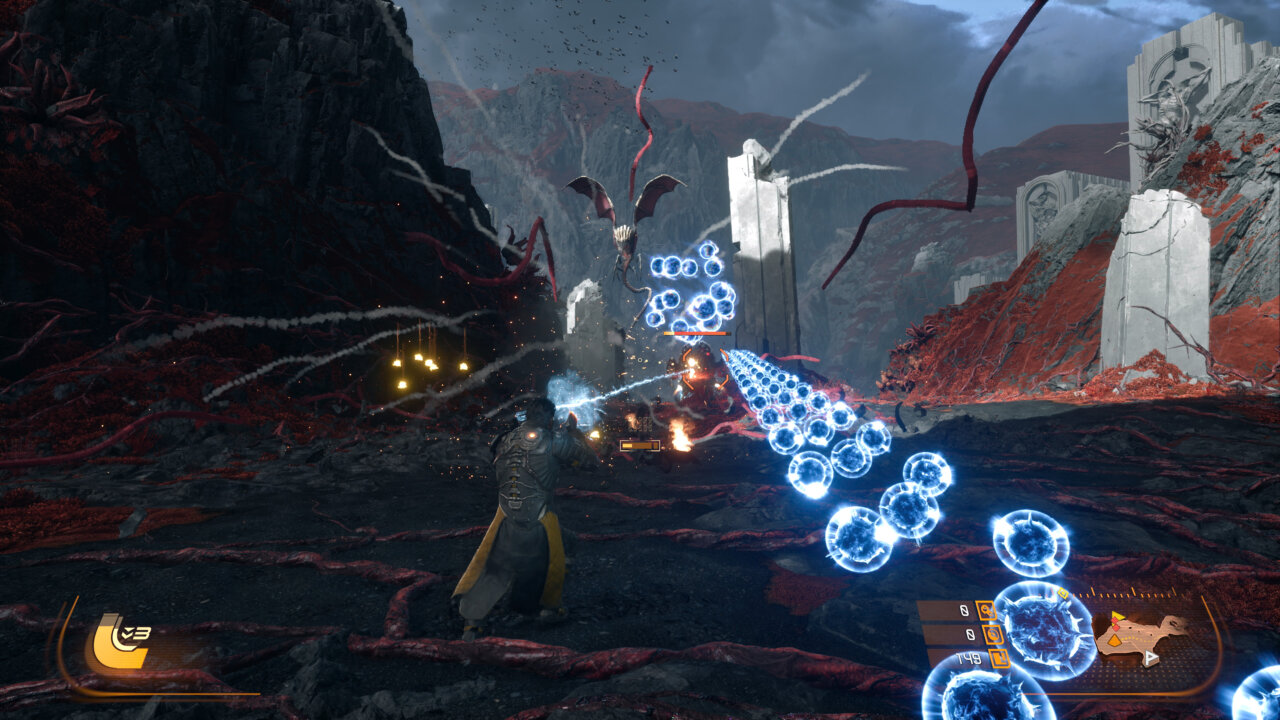
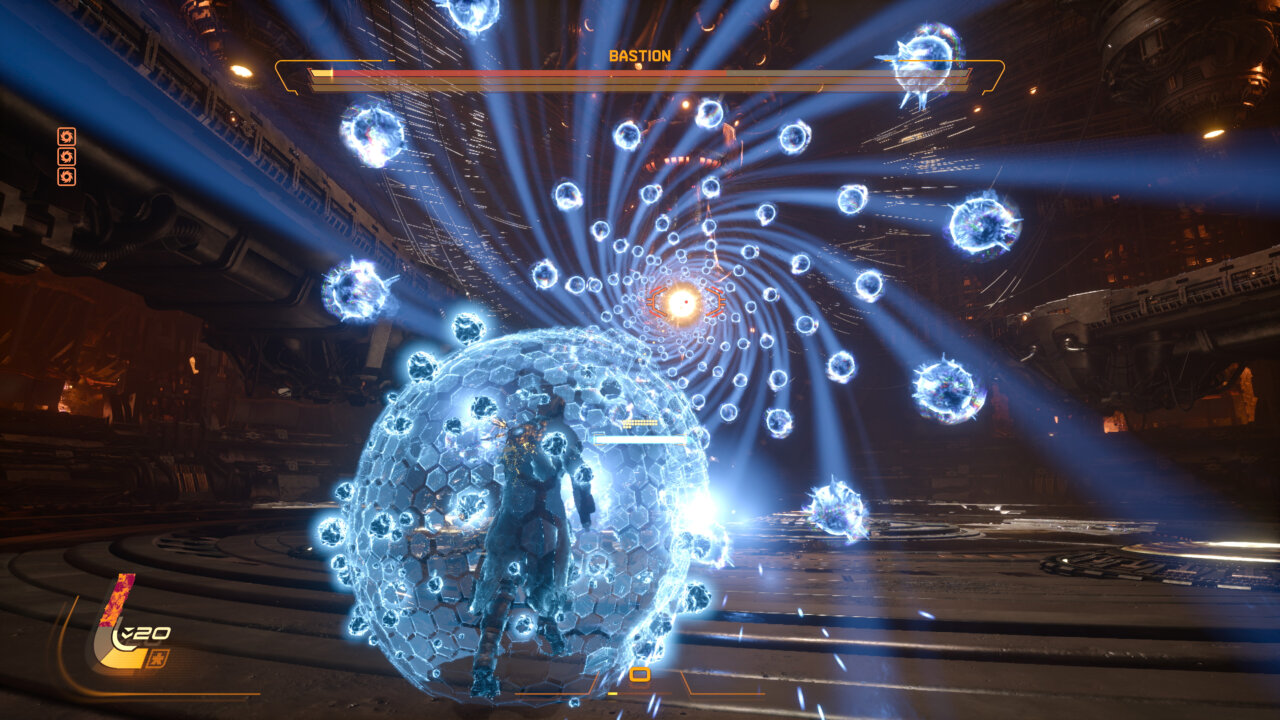
If you’re not familiar with what Saros is or what Returnal was, they are AAA quality roguelike games, which alone is pretty novel in the space. Where indies and small studios have dominated the roguelike space, a surprising few big studios have ever seemed to even toe themselves into the space at all. With Returnal and now Saros, Housemarque has proven that it is possible to make this genre into a full high-budget, high-fidelity game and still retain the charm. A bullet hell game in its own right, Saros will have you find yourself dodging and blocking your way through hundreds of on-screen projectiles at times, and always keeps fights intense. This is where much of the roguelike genre’s typical difficulty finds its way into Saros.
Which brings me to what I mentioned in my opening lines: A common complaint levied at Housemarque with Returnal was that it was just too hard for many people. Personally, I loved Returnal for its difficulty, but it is fair in observing its inherently unfair nature. In Returnal, you could often find yourself losing a run an hour in, losing everything only to have to do it all over again. No problem for those of us glued to our consoles all of our free time, but for the common player out there, losing an hour of gameplay was just too much. Attrition the likes of which invited more likelihood to quit the game entirely out of frustration, Saros seeks to correct this. Don’t get me wrong – Saros is still hard, but… it allows players the ability to tailor their difficulty in a unique way that I’ve not seen before that I can recall.
His function is unlocked after a short time of playing, around the same time you unlock the ability to purchase upgrades. Essentially what they’ve done is they’ve given you a series of buffs and nerfs (called protections and trials in-game respectively) that you can choose from to adjust the way the entire game works in action. You’re allowed to take as many of these as you’d like, but they all have different costs. These costs are weighed against one another, limiting the extent to which you can break the overall balance. You can take some of the simpler buffs to get a little improvement to your quality of life, or you can get large boosts to really improve things. Where it limits you though is in the fact that once you’ve applied at least 3 points worth of buffs, you’re required to apply a nerf to your game before you can apply any more buffs. Want to deal more damage to hostiles with every attack? You might need to make your proficiency levels require more xp. Want to improve the quality of all artifacts you find in a run? You might need to reduce the amount of Lucinite (in-game currency for purchasing upgrades) you’re able to bring home on a death. It’s all balanced in a beautiful way, making the overall challenge remain while making it possible for everyone to be challenged in a way that works best for them.
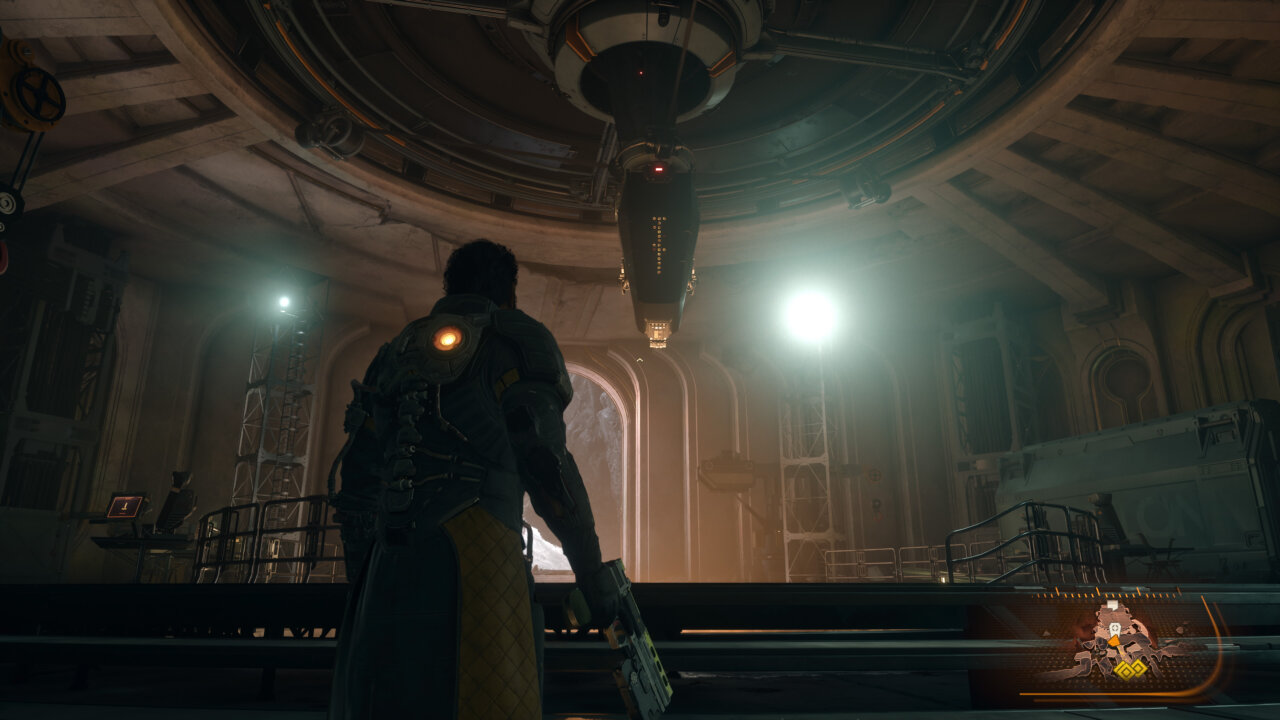
A place where Housemarque excels in general, but especially so with Saros, is their environmental design.Much of the world is visually huge in ways that, while you’re walking through an area, easily produces some of the nicest screenshot material on a constant basis. Many of the various biomes offer cliff-side views that show enormous landscape spanning around you, offering majestic visuals as a rule. Every biome is very different, so there’s a little bit of everything to go around as you progress that you’ll run into. I often felt in my time playing like Saros was engaging itself in a competition to have the highest percentage of screentime spent in the most screenshottable visual space possible. Nary a moment passes by where you aren’t exposed to something extraordinary.
And be exposed you will, as the number of biomes in Saros is double what you would have seen in Returnal. From opulent places, mysterious ruinous ranges akin to something from Prometheus, derilict industrial complexes, to entirely alien conceptual designs, there’s a little of pretty much every sci-fi set dressing present. Playing through, I found myself stopping to think “oh wow, this reminds me of something” constantly. Whether intentional or not, they do pass for their own thing in the end, but the resemblance is often uncanny to other franchises that you likely already know or love. Dune, Alien, Prometheus, Warframe, Death Stranding. All felt like they fed as potential inspirations to many parts of Saros’ set pieces. The cutscenes were no slacker either. Every time the story cuts into a scripted scene, Saros presents some of the most visually interesting and beautifully corrupted animations that I’ve seen in any game. Visual stun seems prevalent in everything Housemarque does, and they do it extremely well.
Saros is a new IP, entirely detached from Returnal, but you’d be hard pressed not to see the DNA of Returnal spread on every part of the game. It’s a glorious, nearly magnum opus presentation in the roguelike space. If you like roguelike games, this is one you should not miss. Likewise,if you like challenging shooters or elliptical storytelling, Saros is also here for you. All three of these things run primarily beside each other throughout the experience, and playing will not disappoint you. An excellent game by any measure, I’d recommend Saros to almost anyone even slightly interested.
Note: Sony Interactive Entertainment provided us with a Saros code for review purposes.
Click Here to buy Saros on Amazon